
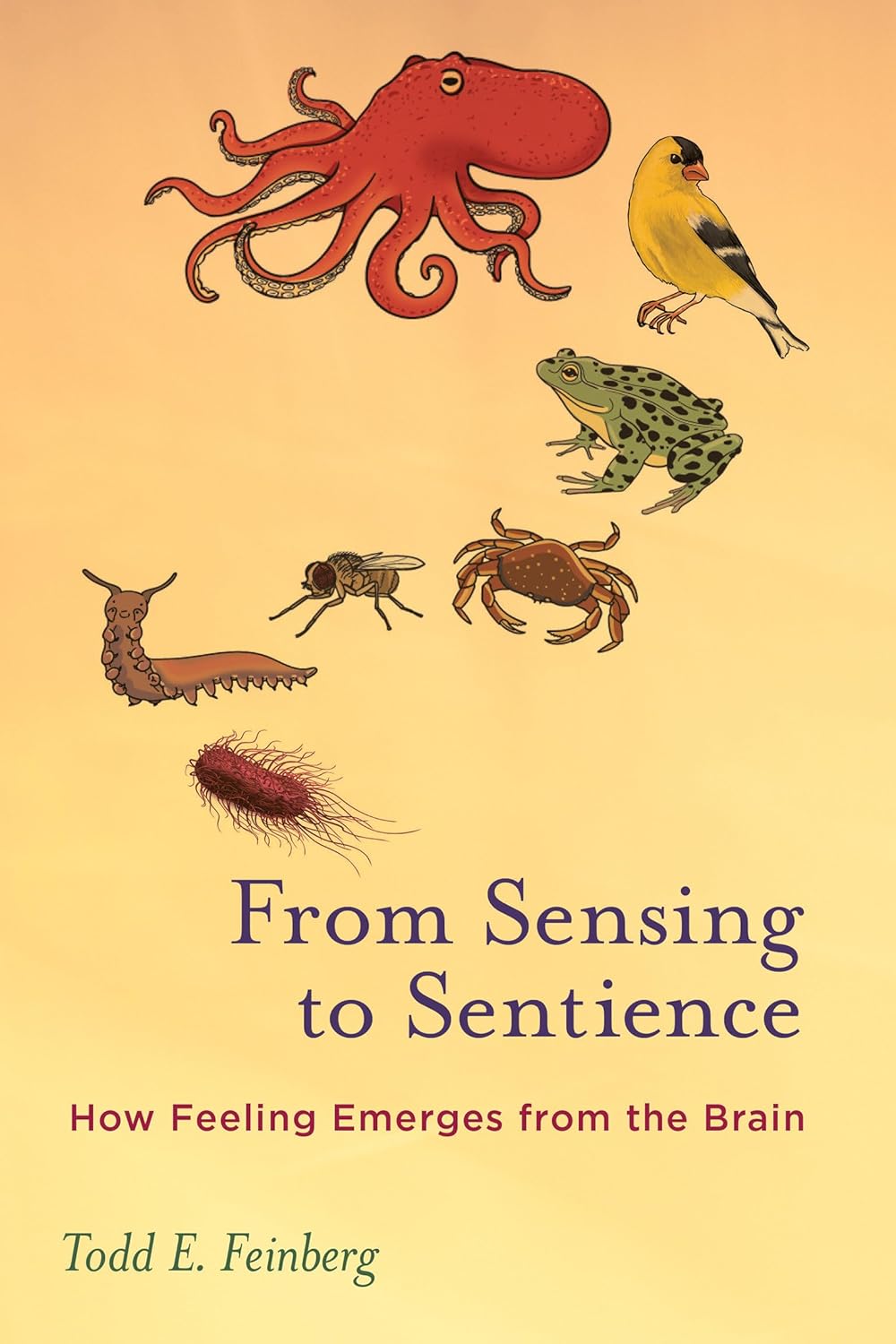
From Sensing to Sentience: How Feeling Emerges from the Brain
Product details
| Management number | 233516439 | Release Date | 2026/06/27 | List Price | $12.07 | Model Number | 233516439 | ||
|---|---|---|---|---|---|---|---|---|---|
| Category | |||||||||
A new theory of Neurobiological Emergentism that explains how sentience emerges from the brain.Sentience is the feeling aspect of consciousness. In From Sensing to Sentience, Todd Feinberg develops a new theory called Neurobiological Emergentism (NBE) that integrates biological, neurobiological, evolutionary, and philosophical perspectives to explain how sentience naturally emerges from the brain.Emergent properties are broadly defined as features of a complex system that are not present in the parts of a system when they are considered in isolation but may emerge as a system feature of those parts and their interactions. Tracing a journey of billions of years of evolution from life to the basic sensing capabilities of single-celled organisms up to the sentience of animals with advanced nervous systems, including all vertebrates (for instance, fish, reptiles, birds, and mammals), arthropods (insects and crabs), and cephalopods such as the octopus, Feinberg argues that sentience gradually but eventually emerged along diverse evolutionary lines with the evolution of sufficiently neurobiologically complex brains during the Cambrian period over 520 million years ago.Ultimately, Feinberg argues that viewing sentience as an emergent process can explain both its neurobiological basis as well its perplexing personal nature, thus solving the historical philosophical problem of the apparent “explanatory gap” between the brain and experience. Read more



Bestseller ranking
Neuroscience


Customers who viewed this product also viewed
Evolution


Correction of product information
If you notice any omissions or errors in the product information on this page, please use the correction request form below.
Correction Request Form